
Ghana’s parliament recently passed legislation that mandates the establishment of a citizenship by investment (CBI) program, making it the latest African nation to move toward formalizing an investment-based pathway to nationality, though the details of what that program will look like remain undefined.
The Ghana Investment Promotion Authority Bill, 2026, passed on March 25 and awaiting presidential assent, contains a clause on the matter.
“The Ministry of the Interior shall, in consultation with the Authority and in accordance with the Constitution and any other applicable legislation, enact legislation relating to citizenship by investment,” reads Clause 39.
No investment thresholds, eligible nationalities, asset classes, or timelines have been specified in the bill. The provision mandates rather than directly establishes a CBI program.
If the president signs the bill into law, it will legally require the Ministry of the Interior and the Ghana Investment Promotion Authority to develop separate CBI legislation.
The president can also reject the bill and return it to parliament with recommendations, albeit that appears unlikely given that parliament is controlled by a majority of the National Democratic Congress, the president’s own party.
Ghana is often ranked among West Africa’s most stable democracies and is the host of the secretariat of the African Continental Free Trade Area.
The investment bill otherwise overhauls Ghana’s investment promotion framework, reducing minimum capital requirements for trading enterprises from US$1 million to US$500,000, introducing a formal investor grievance mechanism, and designating GIPA as the national focal point for investment under the African Continental Free Trade Area protocol.
Prior CBI Proposals
The CBI idea first surfaced publicly during the country’s 2024 presidential elections, when independent presidential candidate Nana Kwame Bediako proposed selling Ghanaian citizenship for $50,000 per applicant, targeting investors of African descent to attract 1 million participants and raise $50 billion.
Bediako framed the initiative as part of a broader Pan-African economic vision, but he ultimately lost the election to John Dramani Mahama, who took office in January 2025.
The new administration’s decision to include a CBI mandate in its flagship investment legislation marks the first time the concept has been codified in Ghanaian law.
Africa’s RCBI Landscape
The news from Ghana comes as investment migration activity across Africa continues to grow.
São Tomé and Príncipe, a small island nation in the Gulf of Guinea, launched a CBI program in September 2025 and issued its first passport in January 2026. The program drew 98 applications from nationals of 27 countries in its first four and a half months.
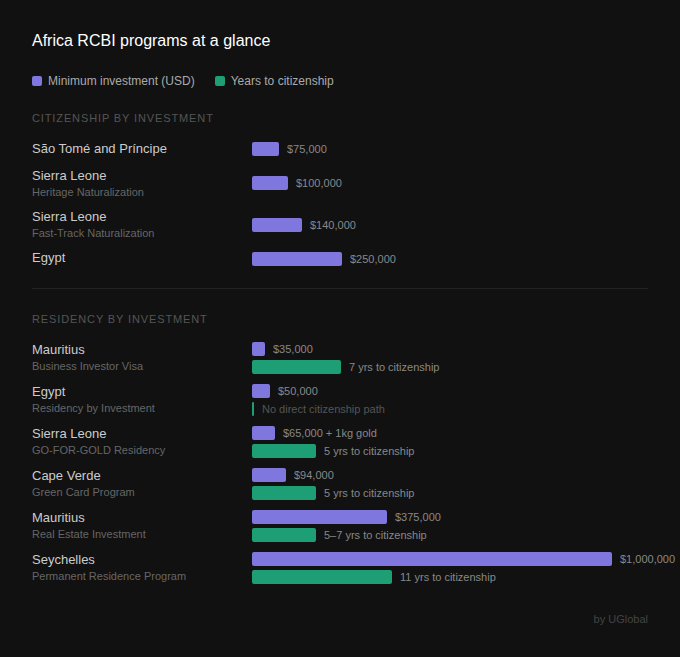
Also, Egypt operates a CBI program with entry points from US$250,000 through donation, real estate purchase, business investment, or bank deposit. Sierra Leone offers a direct citizenship route for an investment made up of $65,000 plus 1 kilogram of gold.
Mauritius offers many investor residency pathways and recently announced a US$1 million investor visa valid for 10 years, but it’s yet to be formally launched.
Kenya and Nigeria have both seen CBI legislation stall. Kenya’s Investment Authority backed draft amendments that lost legislative traction, while a constitutional amendment in Nigeria’s House of Representatives enabling citizenship through investment remains under review.