Hong Kong (SAR)

Hong Kong CIES Residency Program Overview
Hong Kong’s New Capital Investment Entrant Scheme (New CIES) offers residency to high-net-worth individuals who make a qualifying investment in Hong Kong’s financial markets and approved assets.
Applicants must invest a minimum of HK$30 million (approx. US$3.85 million), of which HK$3 million must go into the government-managed CIES Investment Portfolio. The remaining HK$27 million can be invested in permitted assets, including financial instruments and eligible real estate.
No business operation is required, and no minimum physical presence is mandated during the residency period.
Successful applicants receive an initial two-year stay, renewable in three-year increments, with a pathway to permanent residency.
Investors may sponsor their spouse or civil partner and unmarried dependent children under 18 as dependents. Dependants receive linked stay conditions and are free to work and study in Hong Kong without restriction.
Eligibility Requirements
Applicants must be aged 18 or above, demonstrate no adverse immigration or security record, and show the ability to support themselves and any dependents without relying on returns from the qualifying investment, employment, or public assistance.
The scheme is open to foreign nationals (excluding nationals of Afghanistan, Cuba, and the Democratic People’s Republic of Korea), Macao SAR residents, Chinese nationals with overseas permanent residency, stateless persons with permanent residency and proven re-entry facilities, and Chinese residents of Taiwan.
Two core financial requirements must be met: a net asset requirement and an investment requirement, as follows:
Net Asset Requirement
- Net assets or net equity with a market value of not less than HK$30 million (approx. US$3.85 million) to which the applicant is absolutely beneficially entitled
- Must be demonstrated throughout the six months preceding the application for net asset assessment to InvestHK
- Proportionate shares of jointly held assets with family members may be counted toward this requirement
- A Certified Public Accountant (Practising) must be engaged at the applicant’s expense to certify fulfillment
Investment Requirement
- Total minimum investment: HK$30 million Net (approx. US$3.85 million) in permissible investment assets
- Of this, HK$3 million (approx. US$385,000) must be placed into the CIES Investment Portfolio, managed by the Hong Kong Investment Corporation Limited
- The remaining HK$27 million (approx. US$3.47 million) may be invested in any combination of permissible financial assets and/or eligible real estate
- Local assets acquired before 1 March 2024 do not count toward the threshold
Permissible Financial Assets
- Equities listed on the Hong Kong Stock Exchange and traded in Hong Kong dollars
- Debt securities denominated in Hong Kong dollars or Renminbi, issued or guaranteed by the HKSAR Government, the Exchange Fund, designated statutory bodies, or listed companies
- Certificates of deposit denominated in Hong Kong dollars or Renminbi with a remaining maturity of at least 12 months at acquisition, subject to a cap of HK$3 million; must be acquired after Approval-in-Principle is granted
- Subordinated debt denominated in Hong Kong dollars or Renminbi issued by authorized institutions in compliance with the Banking (Capital) Rules
- SFC-authorized eligible collective investment schemes, including unit trusts, mutual funds, investment-linked assurance schemes, open-ended fund companies (OFCs), and limited partnership funds (LPFs); private OFCs and private LPFs are subject to an aggregate cap of HK$10 million
Real Estate
- Non-residential real estate is permitted as a qualifying asset
- Residential real estate is permitted since 16 October 2024, subject to a minimum single-property transaction price of HK$50 million (approx. US$6.43 million)
- The aggregate value of all real estate counted toward the minimum threshold is capped at HK$10 million (approx. US$1.28 million) for properties with completion dates before 17 September 2025
- Real estate may be held in the applicant’s own name, through a sole proprietorship, or through a wholly owned private company, including a Family-owned Investment Holding Vehicle (FIHV)
Route to Citizenship
Hong Kong is a Special Administrative Region of the People’s Republic of China and does not have its own citizenship. The pathway available through the New CIES is to permanent residency, known as the Right of Abode.
After not less than seven years of continuous ordinary residence in Hong Kong, New CIES entrants and their dependants may apply for the Right of Abode.
Ordinary residence means genuinely making Hong Kong one’s habitual home during that period, not merely maintaining a nominal presence.
No minimum annual stay is formally prescribed, but non-Chinese permanent residents can lose their Right of Abode if they depart Hong Kong for more than 36 consecutive months.
Once the Right of Abode is granted, the investment portfolio requirement is lifted and assets can be freely reallocated.
A Hong Kong SAR passport is available only to Chinese nationals who hold valid Hong Kong permanent resident status.
Foreign nationals who obtain the Right of Abode retain their original nationality.
Foreigners wishing to obtain an HKSAR passport must naturalize as Chinese nationals under the Nationality Law of the People’s Republic of China, which requires renouncing their existing citizenship.
Mobility and Taxation
Mobility
New CIES residency grants the right to live, work, and study in Hong Kong for the duration of the permitted stay.
Dependants are free to take up employment and studies without restriction. Holders do not require a re-entry visa to return to Hong Kong within their current limit of stay, provided circumstances remain unchanged.
For holders of passports with limited travel access, Hong Kong residency can function as a credibility signal for visa applications to third countries, including Schengen area states and the United Kingdom. This effect varies by nationality and is not guaranteed.
Upon obtaining the Right of Abode, foreign nationals who subsequently naturalise as Chinese nationals become eligible for an HKSAR passport. As of early 2026, the HKSAR passport provides visa-free or visa-on-arrival access to 175 destinations, including the European Union, the United Kingdom, Japan, Singapore, and Australia.
Taxation
Hong Kong taxes income on a strictly territorial basis: only income arising in or derived from Hong Kong is subject to tax.
Foreign-source income is not taxed regardless of whether the holder is a Hong Kong tax resident. Salaries tax on Hong Kong-sourced employment income is assessed at progressive rates from 2% to 17%. Capital gains are not taxed. Dividend and interest income are exempt from tax.
There is no inheritance tax, wealth tax, or VAT. The New CIES does not impose a tax residency obligation as a condition of the scheme.
Holders who do not establish Hong Kong tax residency (generally, spending at least 180 days in a tax year or 300 days over two consecutive years in Hong Kong) remain subject to tax only on any income actually sourced in Hong Kong.
How to Apply
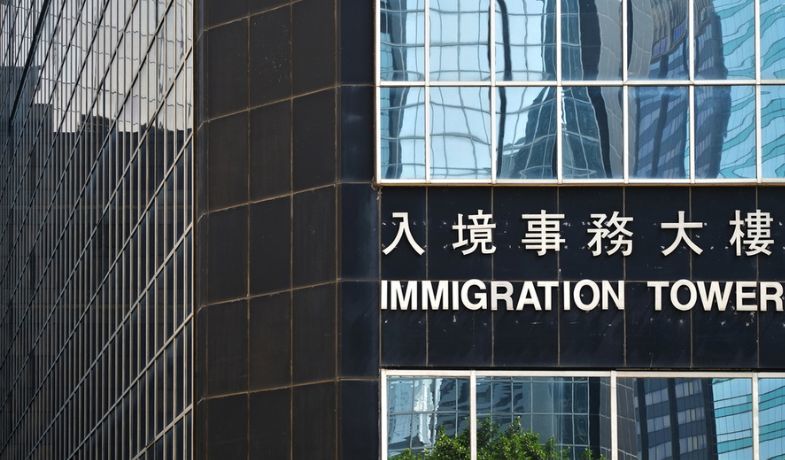
The New CIES is jointly administered by Invest Hong Kong (InvestHK) and the Immigration Department of the HKSAR. InvestHK’s New CIES Office handles net asset assessment, investment verification, and portfolio maintenance compliance.
The Immigration Department handles all visa and entry permit processing. Applications are submitted online via the GovHK portal. Application fees are non-refundable regardless of outcome, and the Director of Immigration retains absolute discretion to approve or disapprove any application. Applicants should verify current requirements directly with InvestHK and the Immigration Department at the time of application.
The typical process runs as follows:
- Step 1: Engage a Certified Public Accountant (Practising) and submit a net asset application to InvestHK demonstrating assets of at least HK$30 million held throughout the preceding six months.
- Step 2: Upon successful assessment, InvestHK issues a Certifying Proof for Fulfillment of Net Asset Requirement.
- Step 3: Submit an entry visa application to the Immigration Department, together with the InvestHK certifying proof and supporting documents including a valid travel document, Certificate of No Criminal Conviction, and proof of overseas permanent residency if applicable.
- Step 4: The Immigration Department issues Approval-in-Principle; the applicant enters Hong Kong on visitor status for up to 180 days to execute the committed investment.
- Step 5: Upon completing the HK$30 million investment, submit to InvestHK for verification; receive Certifying Proof for Fulfillment of Investment Requirements.
- Step 6: Submit the investment certifying proof to the Immigration Department; receive formal approval and an initial 24-month stay for the principal applicant and dependants.
- Step 7: Apply for three-year extensions before each limit of stay expires, providing InvestHK-issued proof of continued portfolio maintenance compliance.
- Step 8: After seven years of continuous ordinary residence, apply to the Immigration Department for the Right of Abode.
Other residency routes in Hong Kong include:
- The Investment as Entrepreneurs Scheme is for foreign entrepreneurs and start-up founders seeking Hong Kong residency by investing in a new or existing business. Applications are assessed on merit and take into account factors including the applicant’s business plan, expected contribution to the Hong Kong economy, financial resources, educational background, technical qualifications, and proven professional experience. There are no fixed minimum investment thresholds. Those seeking to establish or participate in a startup may receive favorable evaluation if the proposed venture is endorsed by a government-backed programme, and applicants must hold pivotal roles such as founder, partner, or key researcher. Note that mainland China nationals are exempt from this scheme unless they have lived outside of mainland China, Hong Kong, and Macao for at least one year prior to applying, hold residency elsewhere, and submit their application from outside mainland China.
- The Quality Migrant Admission Scheme aims to attract highly skilled or talented persons to settle in Hong Kong in order to enhance its economic competitiveness. Applicants must be aged 18 or above, hold a good educational background (normally a first degree from a recognized university), be proficient in Chinese (Putonghua or Cantonese) or English, have no criminal record, and be able to demonstrate sufficient financial means to support themselves and any dependants without relying on public assistance. Applications are assessed under one of two routes: the General Points Test, which awards points across factors including age, academic qualifications, language proficiency, work experience, annual income, and family background; or the Achievement-based Points Test, which is reserved for those with outstanding accomplishments such as Olympic or Nobel laureates. No job offer in Hong Kong is required to be eligible.
- The Top Talent Pass Scheme is open to applicants under one of three categories. Category A is for individuals with annual taxable employment or business income of HK$2.5 million (approx. $320,000) or above in the year preceding the application. Category B is for degree graduates of eligible top-100 universities with at least three years of work experience over the past five years. Category C is for degree graduates of eligible top-100 universities within the past five years with less than three years of work experience, subject to an annual quota of 10,000 places on a first-come, first-served basis; this category does not apply to non-local students who obtained their undergraduate qualification through a full-time locally-accredited program in Hong Kong. All categories are granted a 24-month pass, renewable, with no job offer required at the time of application.
These programs grant temporary residency, which can be extended. After seven years of continuous legal residency in Hong Kong, holders may apply for permanent residency, which confers political and social rights as well as access to public services. Hong Kong, as a Special Administrative Region of China, has its own travel document but not its own citizenship, and therefore, no citizenship by investment program is available.