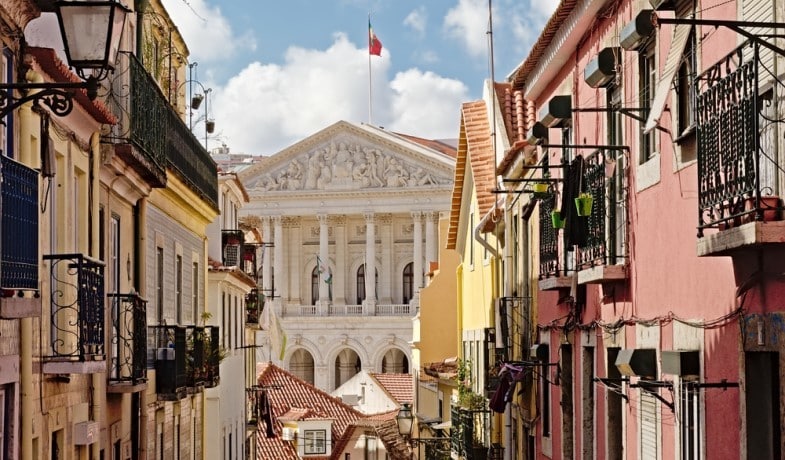
Portugal

Portugal Golden Visa Overview
Portugal’s Golden Visa, officially the Residence Permit for Investment Activity (ARI), has been one of Europe’s most popular investor residency programs since its launch in October 2012.
The program grants non-EU nationals temporary residency through qualifying investments, with a pathway to citizenship within 10 years, or 7 years for nationals of Community of Portuguese Language Countries (CPLP) member states, subject to minimum stay and tax requirements.
Eligibility Requirements
The Portugal Golden Visa is open to non-EU/EEA/Swiss nationals who make a qualifying investment and maintain it for at least 5 years.
Applicants may be eligible for a 20% reduction in the required investment/donation amount if they invest in a low-density area.
Applicants may qualify under one of the following routes:
Cultural Donation: €250,000
- Applicants must contribute to an approved cultural heritage or artistic production project recognized by the Portuguese government.
- All donated funds must be allocated in full to the approved project.
- This route carries the lowest minimum threshold in the program.
Fund Investment: €500,000
- Applicants subscribe to one or more qualifying private equity or venture capital funds regulated by the Portuguese Securities Market Commission (CMVM).
- Funds must have a minimum maturity of five years and must invest at least 60% of their capital in companies headquartered in Portugal.
- Real estate funds and any fund with direct or indirect real estate exposure are excluded.
Business and Job Creation
- Applicants may alternatively qualify by establishing a company in Portugal that creates at least 10 full-time jobs, or by investing at least €500,000 in an existing Portuguese company and generating at least 5 new jobs.
- This route is attractive to entrepreneurs and businessmen seeking active involvement in the Portuguese economy.
Route to Residency
The Golden Visa residence permit is initially valid for 2 years, renewable in 2-year increments, with a minimum physical presence requirement of 14 days in each 2-year period.
Holders can maintain this status indefinitely as long as their investment remains in place.
After five years of legal residency, holders may apply for permanent residency or naturalization, which requires an A2-level Portuguese language test and a clean criminal record; children under ten are exempt from the language requirement.
The naturalization timeline is currently under legislative review. In April 2026, the Parliament approved changes to the nationality law that would extend citizenship timeline to 10 years for most nationalities and 7 years for CPLP citizens. The law is pending presidential approval.
The approved law has no grandfathering provisions, meaning it would apply to all applicants, including those already holding a Golden Visa residence permit, if they haven’t applied for citizenship before the law takes effect.
Applicants should seek independent legal advice and verify the timeline in force at the time of their citizenship submission.
Portugal permits dual nationality, so applicants do not need to renounce their existing citizenship.
Mobility and Taxation
Mobility
Portuguese citizenship provides visa-free or visa-on-arrival access to 184 countries and territories, including the United States, the United Kingdom, Canada, Australia, and Japan.
As an EU member state, Portugal grants its citizens the right to live, work, and study freely across all 27 EU member states, as well as Norway, Iceland, Liechtenstein, and Switzerland, with no residence permit required.
Portugal is also a founding member of the CPLP, the Community of Portuguese Language Countries, which creates additional settlement and mobility ties across eight nations: Brazil, Angola, Mozambique, Cape Verde, Guinea-Bissau, São Tomé and Príncipe, Equatorial Guinea, and East Timor.
Taxation
Portugal’s longstanding Non-Habitual Resident (NHR) tax regime, which closed to new applicants in March 2025, has been replaced by the IFICI program (Tax Incentive for Scientific Research and Innovation), also known as NHR 2.0.
IFICI targets new tax residents who have not been resident in Portugal in the previous five years and who work in qualifying fields such as science, technology, healthcare, higher education, or innovation-driven sectors.
Eligible applicants benefit from a 20% flat personal income tax rate on qualifying Portuguese employment or self-employment income, as well as exemptions on most categories of foreign-sourced income, for a period of ten consecutive years.
Golden Visa holders who do not establish full tax residency in Portugal are not subject to Portuguese income tax on foreign earnings, as they fall below the 183-day threshold required to trigger tax residency.
How to Apply
The Portugal Golden Visa is administered by AIMA (Agency for Integration, Migration and Asylum), operating under Law 23/2007 (the Foreigners Law).
Applications may be submitted digitally through the ARI portal. The process involves three broad stages: making and evidencing the qualifying investment, submitting the application with required documentation through the portal, and attending an in-person biometric appointment at an AIMA office in Portugal.
Biometric appointments are scheduled automatically in the order of document uploads, with applicants typically receiving 30 to 90 days’ advance notice.
Required documentation generally includes a valid passport, Portuguese tax identification number (NIF), proof of the qualifying investment, a clean criminal record certificate from the applicant’s country of residence, and proof of health insurance coverage in Portugal.
Portugal Startup Visa Overview
Portugal offers a residency pathway specifically for entrepreneurs through the Startup Visa, a program that allows non-EU nationals to establish or relocate an innovative, technology-driven business to Portugal in partnership with a certified local incubator.
The program targets founders with scalable, internationally focused business ideas rather than investors making a passive capital commitment. There is no minimum investment amount; eligibility is based on the quality and potential of the business project rather than the capital deployed.
Up to five co-founders may apply together under a single project. Each must be a non-EU, non-EEA, and non-Swiss national.
A spouse and dependent children may be included; family reunification requires the main applicant to have completed at least 2 years of legal residence in Portugal before sponsoring family members, with exceptions for couples with prior cohabitation of 18 months or more and for applicants with minor children.
Eligibility Requirements
All applicants must be at least 18 years of age, hold a clean criminal record, and demonstrate sufficient personal financial means. IAPMEI assesses the business project within 30 working days.
Approval by at least one of the 99 IAPMEI-certified incubators is a prerequisite before the IAPMEI application is submitted.
Business Project Requirements
The business project must meet all of the following criteria to qualify:
- Innovative and technology-driven in nature; traditional or classical business models such as retail, hospitality, or personal services do not qualify
- Scalable with clear potential for international market expansion
- Projected turnover or total asset value exceeding €325,000 per year within five years of the incubation period, demonstrated through a credible financial model in the business plan
- Demonstrable potential to create qualified employment in Portugal
- Already accepted for acceleration by at least one of the 99 certified Portuguese incubators listed on the IAPMEI website; the incubator must issue a declaration of interest before the IAPMEI application is submitted
IAPMEI evaluates projects on five criteria: degree of innovation, business scalability, market potential, management team competence, and potential for creating qualified employment in Portugal.
Personal Financial Requirements
- Main applicant: minimum personal bank balance of €11,040 (approx. US$13,027), representing 12 months of the Portuguese minimum wage
- Each adult co-founder or adult dependent: additional 50% of the annual minimum wage, or €5,520 (approx. US$6,514)
- Each dependent child: additional 30% of the annual minimum wage, or €3,312 (approx. US$3,908)
- Funds must be held in a bank account in the applicant’s name and evidenced by recent bank statements
General Documentation
- Valid passport with at least 3 months of validity beyond the intended stay
- Clean criminal record certificate from each country of residence in the past 5 years, apostilled and translated into Portuguese where required
- Travel health insurance valid for the Schengen Area for at least the duration of the visa
- Detailed business plan in Portuguese or English, covering the innovation concept, market analysis, financial projections for 5 years, team credentials, and employment creation plan
- Declaration of interest from at least one IAPMEI-certified incubator
- IAPMEI Declaration of Participation (issued after project approval, valid for 6 months)
- Proof of sufficient personal financial means per the thresholds above
Route to Citizenship
The IAPMEI Declaration of Participation is valid for 6 months and is used to apply for the Startup Visa at the Portuguese consulate in the applicant’s country of residence.
The visa is valid for 4 months. After arrival in Portugal, the applicant applies to AIMA for a 2-year residence permit, which requires a minimum physical presence of 16 months during the 2-year period with no single absence exceeding 6 consecutive months or 8 non-consecutive months. The permit is renewable for a further 3 years under the same conditions.
After 5 years of lawful and continuous residence in Portugal, holders become eligible for permanent residence through AIMA. Permanent residence grants indefinite right of residence.
Citizenship by naturalization is available after 10 years of lawful residence for most non-EU nationals, or 7 years for EU and CPLP nationals.
All naturalization applicants must demonstrate Portuguese language proficiency at A2 level, pass a civic knowledge test, hold a clean criminal record with no convictions carrying a sentence of 3 years or more, and maintain effective residence throughout the qualifying period.
Portugal permits dual nationality; applicants are not required to relinquish their prior citizenship.
Mobility and Taxation
Mobility
Portuguese citizens can access approximately 188 destinations visa-free or visa-on-arrival, ranking among the top five passports globally, including the United States, the United Kingdom, all EU and Schengen member states, Japan, Australia, and Canada. The Startup Visa residence permit grants holders the right to live and work in Portugal and to travel freely within all 29 Schengen member states for the full duration of the permit.
As an EU member state, Portugal grants its citizens full freedom of movement across all 27 EU member states and the EEA.
Tax
Portugal taxes tax residents on worldwide income. Startup Visa holders who spend more than 183 days per year in Portugal, or who maintain their habitual residence there, are considered Portuguese tax residents and are subject to Portuguese personal income tax at progressive rates from 13% to 48% on all worldwide income.
Qualifying founders engaged in research, technology development, or other eligible high-value-added activities may benefit from the IFICI regime (Incentive for Scientific Research and Innovation), which provides a reduced flat rate on qualifying Portuguese-sourced income for up to 10 years.
IFICI eligibility is assessed on a case-by-case basis depending on the nature of the startup activity.
How to Apply
The program is administered by the Portuguese Agency for Competitiveness and Innovation (IAPMEI) for the project assessment stage, and by the Agency for Integration, Migration and Asylum (AIMA) for the residence permit stage. The visa is issued by Portuguese consulates under the Ministry of Foreign Affairs. The process runs in three sequential stages. The process typically runs as follows.
- Step 1: Research and approach IAPMEI-certified incubators from the official list published at the National Network of Incubators (RNI) website; prepare the business plan and obtain a declaration of interest from at least one incubator before submitting the IAPMEI application; incubator monthly fees range from €50 to €400 depending on the services included.
- Step 2: Register on the IAPMEI Startup Visa portal and submit the application with the full business plan, incubator declaration of interest, team CVs, personal financial evidence, passport copies, and criminal record certificates; IAPMEI processes the application within 30 working days and issues the Declaration of Participation upon approval; the declaration is valid for 6 months.
- Step 3: Apply for the Startup Visa at the Portuguese consulate in the country of residence with the IAPMEI Declaration of Participation and all required personal documents; pay the €110 visa application fee; consular processing typically takes 30 to 90 days.
- Step 4: Enter Portugal on the Startup Visa within its 4-month validity; sign the incubation agreement with the chosen certified incubator; register the residential address with the local Junta de Freguesia; obtain a Portuguese Tax Identification Number (NIF) if not already held.
- Step 5: Schedule and attend an AIMA appointment to apply for the 2-year residence permit; provide all original documents including the IAPMEI Declaration, incubation contract, bank statements confirming personal financial means, accommodation proof, and passport; pay the AIMA fee of approximately €160 to €170 per person.
- Step 6: Operate within the incubation program; maintain minimum physical presence of 16 months during the 2-year permit period; apply for the 3-year renewal before the permit expires.
Portugal D7 Passive Income Visa Overview
The Portugal D7 Visa, officially designated as the Residence Visa for Passive Income, is open to non-EU, non-EEA, and non-Swiss nationals who can demonstrate a stable and regular passive income of at least €920 (approx. US$1,086) per month from sources outside Portugal.
The residence permit is valid for 2 years and renewable for a further 3 years, after which permanent residence is available.
Holders must be physically present in Portugal for a minimum of 16 months during the initial 2-year permit period, with no single absence exceeding 6 consecutive months or 8 non-consecutive months.
Eligibility Requirements
Applications for the D7 visa are submitted to the Portuguese consulate or embassy in the applicant’s country of residence, under Article 77 of Law 23/2007 as amended by Law 61/2025. Applications are assessed by the consulate and, at the residence permit stage, by AIMA. Applicants must be at least 18 years of age, hold a clean criminal record, and demonstrate qualifying passive income from non-Portuguese sources. The income threshold is indexed to the Portuguese national minimum wage and is updated annually.
Income Requirements
- Main applicant: minimum €920 (approx. US$1,086) per month in passive income, or €11,040 (approx. US$13,027) per year
- Spouse: additional 50% of the minimum, or €460 (approx. US$543) per month
- Each dependent child: additional 30% of the minimum, or €276 (approx. US$326) per month
- Eligible income types include pensions, dividends, rental income from property outside Portugal, royalties, interest, and regular distributions from investments or trusts; remote employment income from a non-Portuguese employer may also qualify at the consulate’s discretion
- Income must be regular, stable, and demonstrable through bank statements for a minimum of the preceding 3 months; annual tax returns and proof of the income source are also required
Bank Balance Requirement
- Recommended minimum balance of €11,040 (approx. US$13,027) in a Portuguese licensed bank account at the time of the AIMA residence permit appointment, representing 12 months of the minimum income threshold
- The Portuguese bank account must be opened before the AIMA appointment; a Portuguese Tax Identification Number (NIF) is required to open the account and must be obtained before submitting the visa application
Accommodation
- Proof of long-term accommodation in Portugal is required, either through a minimum 12-month rental agreement registered with the Portuguese tax authority (AT), a property purchase deed, or a certified letter of accommodation from a close family member resident in Portugal
- Short-term rental agreements and hotel bookings do not qualify
General Documentation
- Valid passport with at least 3 months of validity beyond the intended stay
- Clean criminal record certificate from each country of residence in the past 5 years, apostilled and translated into Portuguese where required
- Travel health insurance with coverage for the entire Schengen Area, valid for at least the duration of the visa
- Completed visa application form and recent passport-sized photograph
- Proof of NIF and Portuguese bank account
Route to Citizenship
The D7 residence permit is valid for 2 years from the date of AIMA issuance and is renewable for a further 3-year period. The renewal requires continued compliance with the income, accommodation, and minimum stay conditions.
After 5 years of lawful and continuous residence in Portugal, holders become eligible to apply for permanent residence through AIMA. Permanent residence grants indefinite right of residence without further renewal obligations.
Portuguese citizenship by naturalization is available after a minimum of 10 years of lawful residence in Portugal for most non-EU nationals, or 7 years for citizens of EU member states and CPLP countries, under the revised Nationality Law signed into law on 3 May 2026.
All naturalization applicants must demonstrate Portuguese language proficiency at A2 level, pass a civic knowledge test covering Portuguese history and democratic values, hold a clean criminal record with no convictions carrying a sentence of 3 years or more, demonstrate ties to the Portuguese national community, and have maintained effective residence in Portugal throughout the qualifying period.
Mobility and Taxation
Mobility
Portuguese citizens can access approximately 188 destinations visa-free or visa-on-arrival, including the United States, the United Kingdom, all EU and Schengen member states, Japan, Australia, and Canada, ranking among the top five passports globally.
The D7 residence permit grants holders the right to live in Portugal and to travel freely within the Schengen Area for the full duration of the permit, covering all 29 Schengen member states without requiring a separate visa.
As an EU member state, Portugal grants its citizens full freedom of movement across all 27 EU member states.
Tax
Portugal taxes tax residents on worldwide income. An individual is considered a Portuguese tax resident if they spend more than 183 days per year in Portugal or maintain a habitual residence there.
Since the D7 visa requires at least 16 months of physical presence over 2 years, most D7 holders will qualify as Portuguese tax residents from the first year of residence.
Tax-resident D7 holders are subject to Portuguese personal income tax at progressive rates from 13% to 48% on all worldwide income.
Portugal has double taxation agreements with over 80 countries, which may reduce withholding taxes on income received from abroad.
How to Apply
The visa stage is administered by Portuguese consulates and embassies worldwide under the Ministry of Foreign Affairs. The residence permit stage is administered by the Agency for Integration, Migration and Asylum under the Ministry of Internal Administration. The process runs in two mandatory sequential stages.
The process typically runs as follows.
- Step 1: Obtain a Portuguese Tax Identification Number (NIF) either remotely through a Portuguese tax representative or in person at a local Finanças office; open a Portuguese bank account using the NIF and fund it with a recommended minimum of €11,040.
- Step 2: Secure long-term accommodation in Portugal through a minimum 12-month rental agreement registered with the Portuguese tax authority or a property purchase deed; short-term rentals do not qualify.
- Step 3: Compile all required documents including a valid passport, criminal record certificate apostilled and translated into Portuguese, 3 months of bank statements demonstrating the minimum income threshold, proof of income source, accommodation proof, travel health insurance, NIF certificate, and Portuguese bank account statement; complete the online visa application form.
- Step 4: Submit the D7 visa application in person at the Portuguese consulate or embassy in the country of residence; pay the €110 visa application fee; processing typically takes 30 to 90 days; upon approval, the visa is valid for 4 months.
- Step 5: Travel to Portugal within the 4-month visa validity; register the residential address with the local Junta de Freguesia and, for non-EU nationals, notify AIMA of arrival.
- Step 6: Schedule an AIMA appointment to apply for the 2-year residence permit as soon as possible after arrival, as appointment slots can be limited; attend the appointment with all original documents and biometric data; pay the AIMA residence permit fee of approximately €160 to €170 per person.
- Step 7: Receive the residence permit card; maintain minimum physical presence and income requirements throughout the permit period; apply for renewal before expiry.
- Applicants should verify current income thresholds, AIMA appointment availability, and any updates to the Nationality Law timeline directly with the Agency for Integration, Migration and Asylum and the nearest Portuguese consulate at the time of application, as thresholds are indexed annually to the minimum wage and the nationality law changes are pending final publication.