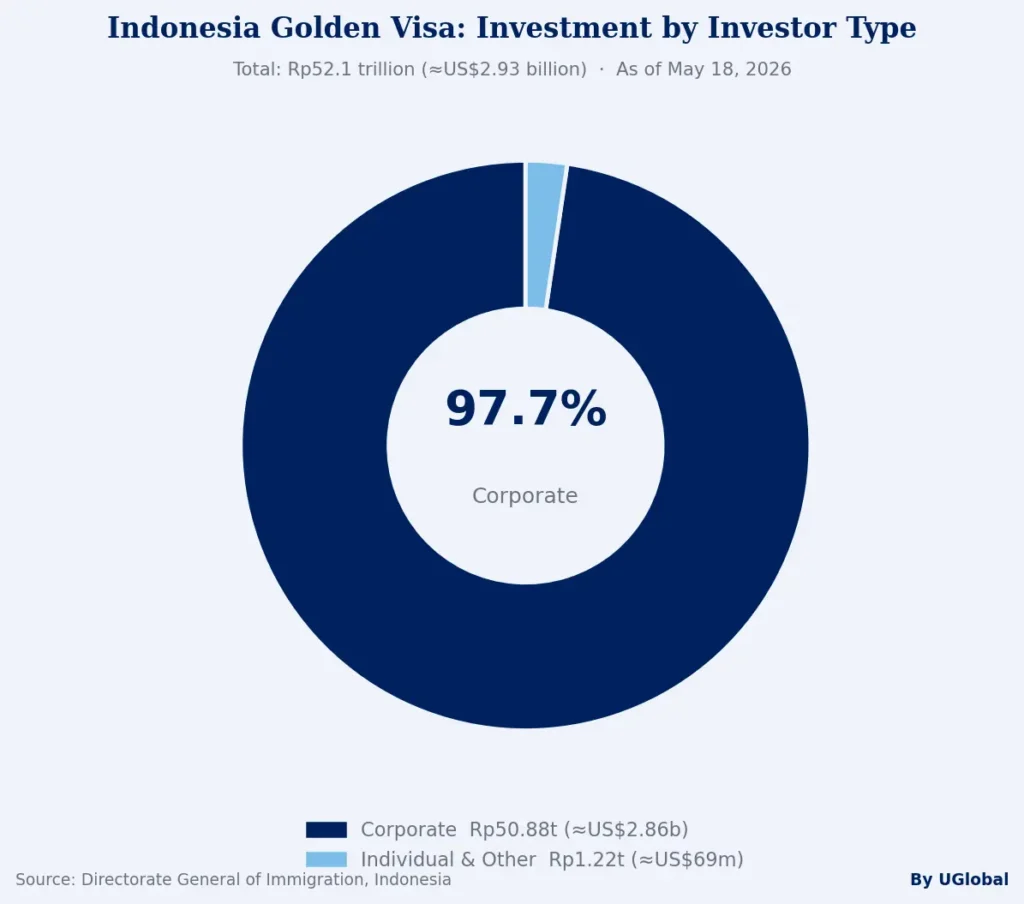
Indonesia’s golden visa program has generated Rp52.1 trillion (approximately US$2.93 billion) in investment since its July 2024 launch, the country’s Directorate General of Immigration announced at a recent press conference in Jakarta.
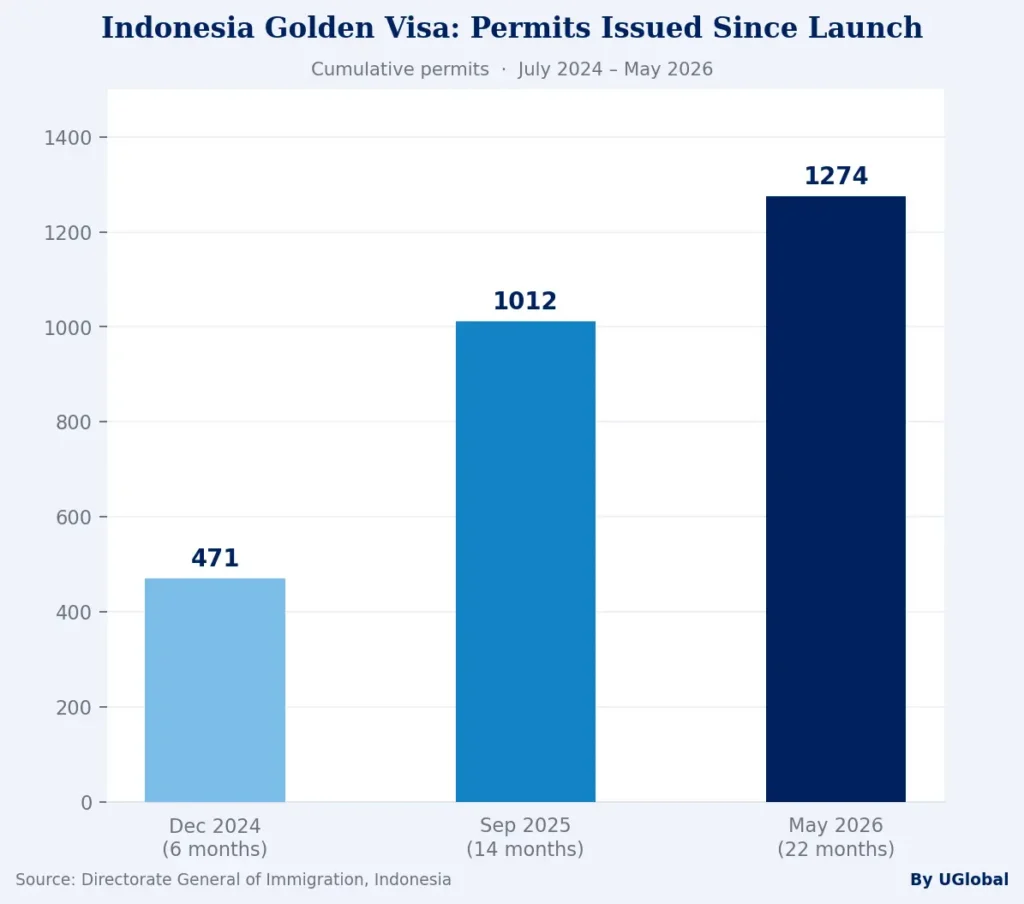
The figure corresponds to 1,274 permits issued to individual and corporate investors as of May 18, 2026. Corporate investors drove the bulk of that capital, contributing Rp50.88 trillion (approximately US$2.86 billion), or nearly 98% of the total. Individual investors and other categories, including second home visa holders and former Indonesian citizens, accounted for the remainder.
The program has also generated more than Rp16.3 billion (approximately US$916,000) in non-tax state revenue from application and processing fees.
From launch through September 2025, the program issued 1,012 permits representing roughly Rp48 trillion (approximately US$2.70 billion) in investment.
Between September 2025 and May 2026, 262 additional permits were issued, adding Rp4.1 trillion (approximately US$230.5 million), a pace roughly half that of the program’s first year.
Director General of Immigration Hendarsam Marantoko described the overall results as evidence of growing global confidence in Indonesia. “This policy has delivered tangible benefits to the national economy,” he said.
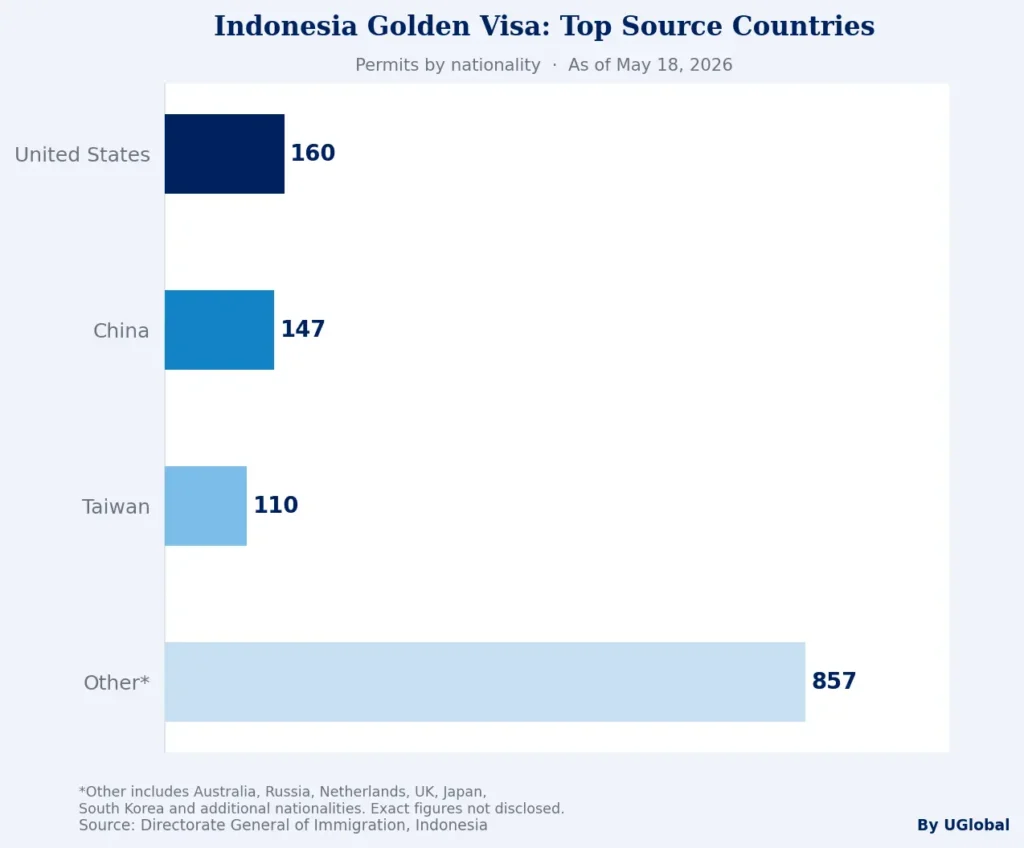
Americans hold the largest share of golden visa recipients, with 160, followed by Chinese nationals at 147 and Taiwanese at 110. Australia, Russia, the Netherlands, the United Kingdom, Japan, and South Korea round out the top source countries.
How the Program Works
Indonesia’s golden visa grants residency for five to ten years to foreign nationals and corporate investors who meet specific investment criteria.
The program operates across several categories. Individual investors who do not wish to establish a company can qualify by investing in government bonds, publicly listed shares on the Indonesian Stock Exchange, or mutual funds.
Individual investor thresholds start at US$350,000 for a five-year permit and US$700,000 for a ten-year permit. The investment must be maintained throughout the visa duration.
Individuals who establish a company in Indonesia face higher requirements. A five-year residency permit requires a company investment of US$2.5 million, while a ten-year permit requires US$5 million.
Corporate investors face significantly higher thresholds: US$25 million for five-year visas covering directors and commissioners, or US$50 million for ten-year permits.
The program also includes additional categories. These cover “silver hair” retirees, “second home” applicants, global talent, and investors in Ibu Kota Nusantara (IKN), Indonesia’s new capital.
In January 2026, the government reduced IKN golden visa thresholds to US$5 million for five years and US$10 million for ten years.
Once in Indonesia with a golden visa, holders do not need to apply for additional permits for authorization to stay or work in the country. They also receive priority airport lanes and streamlined immigration services.
How Indonesia Compares in Southeast Asia
Indonesia’s US$350,000 individual entry point sits at the accessible end of Southeast Asia’s investor visa market. Singapore’s Global Investor Program, the region’s most demanding program, requires a minimum of SGD 10 million (approximately US$7.8 million) for direct business investment.
Over the ten years from 2015 to 2025, Singapore granted permanent residency to around 450 individuals through the GIP, with approximately SGD500 million invested directly in Singapore-based businesses and a further SGD430 million placed in approved funds. Indonesia surpassed that investment total in under two years, though at significantly lower thresholds and without a pathway to permanent residency.
Thailand’s Long-Term Resident Visa requires wealthy global citizen applicants to hold a minimum of US$1 million in global assets and invest at least US$500,000 in Thai government bonds, local businesses, or property.
Malaysia’s MM2H program starts at a fixed bank deposit of MYR 500,000 (approximately US$112,000) for its Silver tier, rising to MYR 2 million (approximately US$450,000) for Platinum.